Plus Size Swim Tops That Actually Stay Put: Why Most Fail & How to Choose Ones That Don’t
Plus Size Swim Tops That Actually Stay Put: Why Most Fail & How to Choose Ones That Don’t
A no-nonsense guide to bands, side wings, straps, cups, and stretch recovery—because “more fabric” is not the same thing as support.

The same four complaints follow me into almost every fitting room: the straps dig in, the cup edge gaps, the band offers no real support, and the top starts sliding the moment someone reaches for a towel. Women shopping for plus size swim tops are often told the answer is simply a bigger size. It usually isn’t. A bigger plus size swim top can give you more fabric while leaving the band too loose, the straps too widely placed, and the cup completely wrong for your breast shape.
After eight years of styling curvy swimwear, I have learned to look past the size label and read the top like a piece of equipment. Where does the weight go? What stops the band from riding up? Does the fabric return to its original shape after it stretches? Can the cup hold the breast from the side as well as the front? When those questions have good answers, a swim top feels quiet—you stop thinking about it and get on with swimming, walking, or chasing children around the pool.
Why Most Plus Size Swim Tops Fail
The industry’s most common shortcut is grading: take a swim top designed around a smaller sample size and enlarge every pattern piece by a set amount. The cup becomes larger, but so do the neckline, strap spacing, armhole, and back. That assumes every part of a curvy body expands at the same rate. Real bodies do not work that way.
A fuller bust may need more cup depth without needing a much wider shoulder position. A broader rib cage may need a longer band without needing a taller cup. Someone with soft breast tissue may need a higher center front and firmer side containment, while someone with a shallow upper bust may need less volume at the top of the cup. When a brand only “sizes up,” these relationships are lost. That is how you end up tightening the straps to compensate for a loose band, then wondering why your shoulders hurt.
The second failure is cosmetic support. Thick fabric, removable pads, and wide-looking straps can appear supportive in a product photo without providing stability. A pad may add shape without controlling movement, while a double layer can feel substantial when dry and become heavy once soaked.
The third issue is fabric fatigue. Swim fabric needs stretch, but it also needs recovery—the ability to return after being pulled. If the band stretches easily and stays stretched, it may feel comfortable in the fitting room and loose in the water. This is why the best plus size swim tops that stay put combine deliberate pattern engineering with material that resists bagging.
What Supportive Plus Size Swim Tops Are Built From
Good support is not one heroic feature. It is a chain, and every link has to agree with the next. I assess five zones in the same order:
The underband should anchor, not squeeze
The band is the foundation. It should sit level around the body and feel firm enough that two fingers can slide underneath without the fabric drifting upward. Wider is often useful, but width alone is not the point; the elastic must have consistent tension and the closure must let you tune the circumference. If the back climbs when you lift your arms, the band is too loose or too stretchy.
Side support prevents the “escaping cup” problem
Many plus size swim tops for large bust focus on front coverage and forget the side. A taller, firmer wing helps guide tissue forward and keeps the cup edge close near the arm. Look at the seam between the cup and side wing: it should feel stable, lie flat, and avoid cutting through the fullest part of the breast.
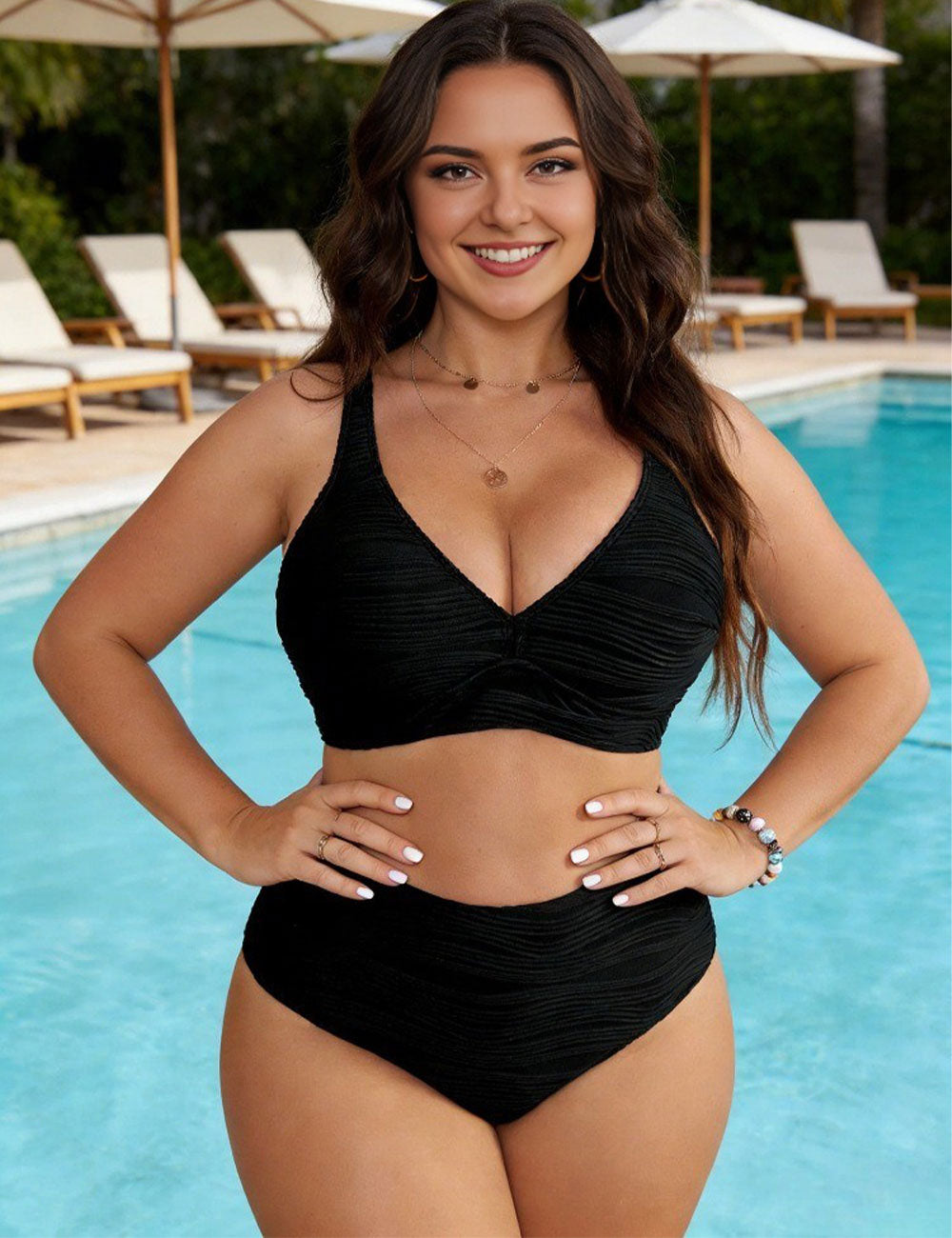
Spread pressure without losing shape
This textured black set uses adjustable wide straps and a deep V front. The value is not simply that the straps look substantial; adjustment lets you position the neckline while the band remains responsible for the anchor.
View the wide-strap setThe cup must match depth and shape
Cup size is not just volume. A molded cup can be too tall, too shallow, or too open at the top even when the label looks correct. Gapping near the neckline often means the cup shape is wrong, not automatically too large. Spillage at the center or side usually means you need more depth or containment. With underwire plus size swim tops, the wire should surround breast tissue and sit against the rib cage; it should never rest on the breast itself.
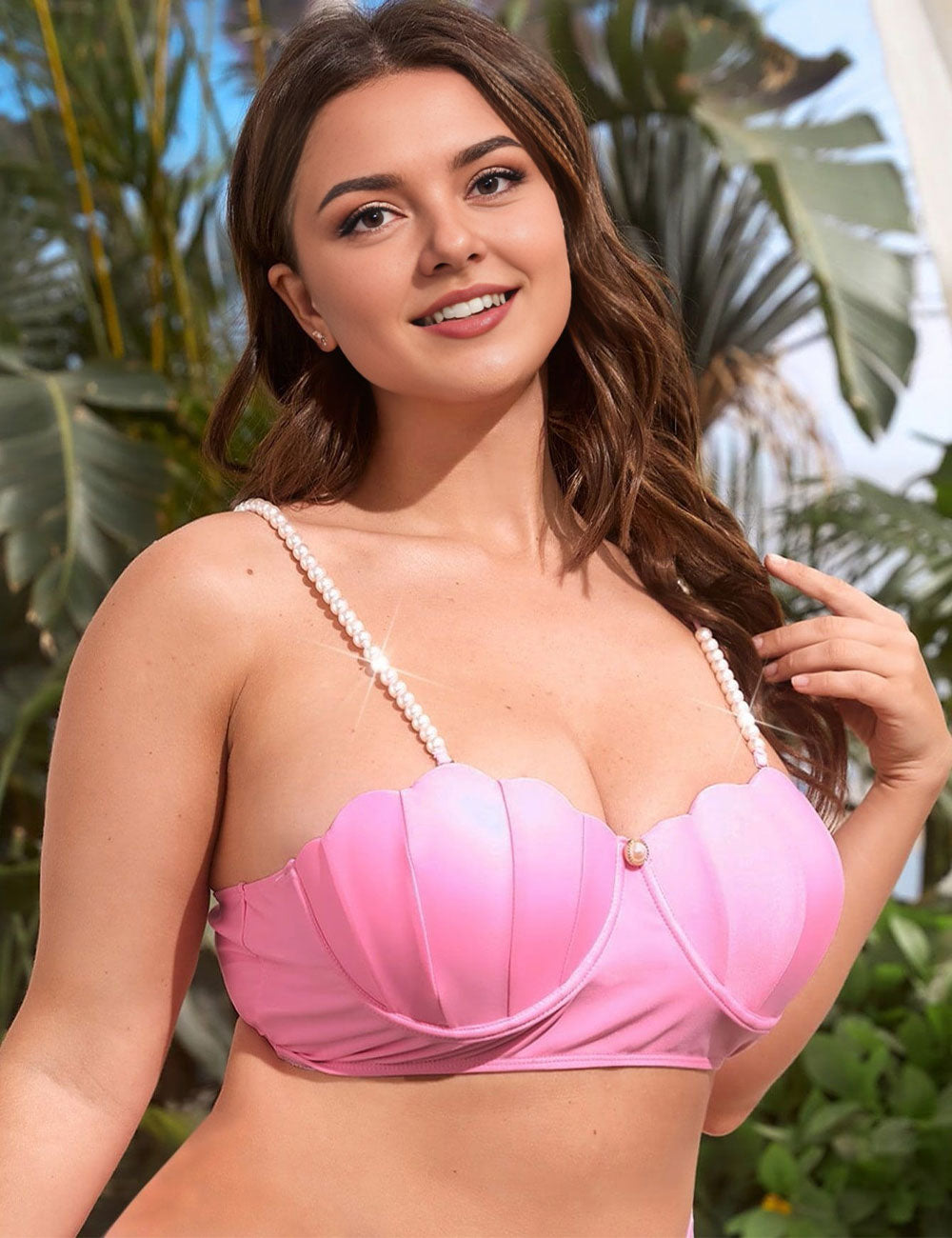
Choose cup architecture for definition
The shell-shaped cups and underwire create a clear boundary around the bust. This kind of top suits someone prioritizing lift and a defined neckline; for active swimming, test the strap security and band tension with extra care.
View the underwire topStrap position matters as much as strap width
Straps placed too close to the arm edge tend to slip from sloping or narrow shoulders. Straps placed too close to the neck can concentrate pressure. The best position follows your frame, which is why adjustable plus size swim tops are so useful. Check both length and placement: a multiway or tie-back design can solve fit differences that a fixed straight strap cannot.
Fabric should stretch—and come back
Pinch a small section of the band, stretch it for three seconds, then release. It should return quickly without rippling. Ribbed and textured materials may feel supportive, but the hidden elastic and lining determine whether the top holds its shape when wet.
How to Judge a Plus Size Swim Top Yourself
You do not need to be a patternmaker to spot a weak top. Put it on, adjust the band first, then set the straps. After that, use this five-minute fitting-room test. Do not stand perfectly still in front of the mirror; support problems show up during movement.
Then look at the top from the side. The band should be horizontal, not dipping under the weight of the bust. Lean forward as if picking up a beach bag. If the neckline opens or breast tissue shifts out of the cup, you need a closer neckline, more cup depth, or a firmer band.
I also ask clients to loosen each shoulder strap by half an inch. If the entire top collapses immediately, the straps were compensating for a band that was not doing its job. Truly supportive plus size swim tops remain anchored even when the shoulder tension is relaxed slightly.

Fine-tune the band around your body
A tie-back can adapt when your bust and rib-cage proportions do not match a fixed closure. Tie it firmly enough to stay level, then confirm that the knot remains comfortable against a chair or lounger.
View the adjustable setChoose Plus Size Swim Tops by What You Actually Do
There is no single “most supportive” style for every situation. The right amount and type of support depends on how you move, how much shaping you want, and which sensation you find comfortable. Start with your real day, not an imaginary product photo.
For a fuller bust
Prioritize a firm underband, tall side wings, adjustable wide straps, and cups with enough depth. Underwire can give separation, while a structured wireless top can work if its band and internal sling are substantial.
For active swimming
Choose a closer neckline, secure back, and straps that cannot drift. A cross-back or carefully tied back can reduce movement. Perform the reach-and-bend test before trusting a fashion-forward cutout.
For relaxed resort wear
You can trade some containment for neckline, texture, or decorative straps—but the band should still stay level. Bring a more secure top if the day may shift from lounging to water sports.
When shopping online, study the back photo as carefully as the front. Look for a closure or tie, strap adjusters, side-wing height, and cup seams. A description that only says “supportive” without naming a construction feature is giving you a mood, not useful fit information.
The CurvySwim swim tops collection is useful when you want to compare stand-alone top shapes, while the plus-size bikini collection lets you judge how the top works within a complete set. Use the product page images to inspect front, side, and back—not just color.
Plus Size Swim Top FAQ
Should a plus size swim top feel tight when it is dry?
The band should feel firm and secure, not painful or restrictive. Swim fabric often relaxes slightly in water, so a band that already feels loose when dry is unlikely to become more supportive when wet.
Are underwire plus size swim tops always better for a large bust?
No. Underwire is excellent for lift and separation when the wire fits correctly. A structured wireless top can also work well if it has a strong band, tall side support, suitable cup depth, and stable straps.
Why does the cup gap even when the size seems right?
The cup may be too tall, too shallow at the bottom, or too open along the neckline. Try a different cup shape before assuming you need to size down, because a smaller cup can create new spillage at the side or center.
How can I stop swim-top straps from slipping?
Check the band first, then adjust strap length. If slipping continues, choose straps placed slightly closer together, a cross-back configuration, or a tie-back style that better matches your shoulder width and slope.
Support should come from the whole top
A reliable swim top is not simply a larger version of a smaller one. It is a system: an underband that anchors, side wings that contain, cups that match your shape, straps positioned for your frame, and fabric that recovers after stretching.
Once you learn to assess those five zones, shopping becomes much less mysterious. You stop asking whether a top looks supportive and start checking whether it is built to support you. That shift is what separates a swimsuit you constantly manage from one you can put on, move in, and forget about.


Comments
Post a Comment